Stock Valuation with AI Agents
Stock Valuation with AI Agents
At bosq, we like turning complex ideas into reliable, clear, production-ready systems. finance-ai was born from exactly that premise: an open-source app for testing stock valuation with a multi-agent architecture, a conversational interface, and a strong focus on transparency of assumptions.
What is finance-ai
finance-ai is a chat-based stock valuation app that combines a Streamlit interface with a team of agents responsible for interpreting user requests, fetching fundamental data, and running valuation calculations. The project was built with CrewAI, Claude, and Streamlit, and was designed as an experimental, open-source module for hands-on exploration of AI-assisted financial workflows.
Why we built this at bosq
At bosq, our approach combines clarity of scope, incremental execution, and verifiable deliverables. Rather than treating AI as a "magic" layer, we prefer to design systems where every step has clear ownership, observability, and auditability. finance-ai is a good example of that philosophy applied to a concrete problem: structuring an agent-assisted financial analysis workflow.
This kind of project also shows how copilots and automations can move beyond generic demos and into more specific use cases, with business context, human validation, and explicit rules. That is exactly the direction we pursue in the products and modules built at bosq.
How the multi-agent architecture works
The app's logic is straightforward to explain and powerful in practice. User interactions flow through a crew with three main roles:
- Orchestrator: understands the request, identifies the ticker and valuation method, and asks for additional parameters when needed.
- Researcher: fetches fundamental data from the web.
- Calculator: runs the valuation methods implemented in the project.
This separation reduces coupling, makes the workflow more auditable, and creates a more robust experience than a single agent trying to do everything at once.
Supported valuation methods
The app already supports five valuation approaches:
- 3-Stage DCF, discounted cash flow with high-growth, transition, and perpetuity phases
- Graham adjusted for Selic, an adaptation of the classic model to the Brazilian interest rate context
- Bazin, ceiling price based on dividend yield
- Peter Lynch, fair value via implied PEG ratio
- Gordon DDM, perpetual dividend discount model
In practice, this enables everything from direct questions like "What is the fair value of PETR4 using DCF?" to side-by-side method comparisons for the same asset. And when parameters are missing, the system asks for them in the chat before running any calculation.
The product experience in practice
One of the most interesting aspects of finance-ai is the combination of a simple interface with transparent execution. The user submits a request like "Evaluate BBAS3," and the system shows not just the final result, but also the live progress of the agents and each research and calculation step.
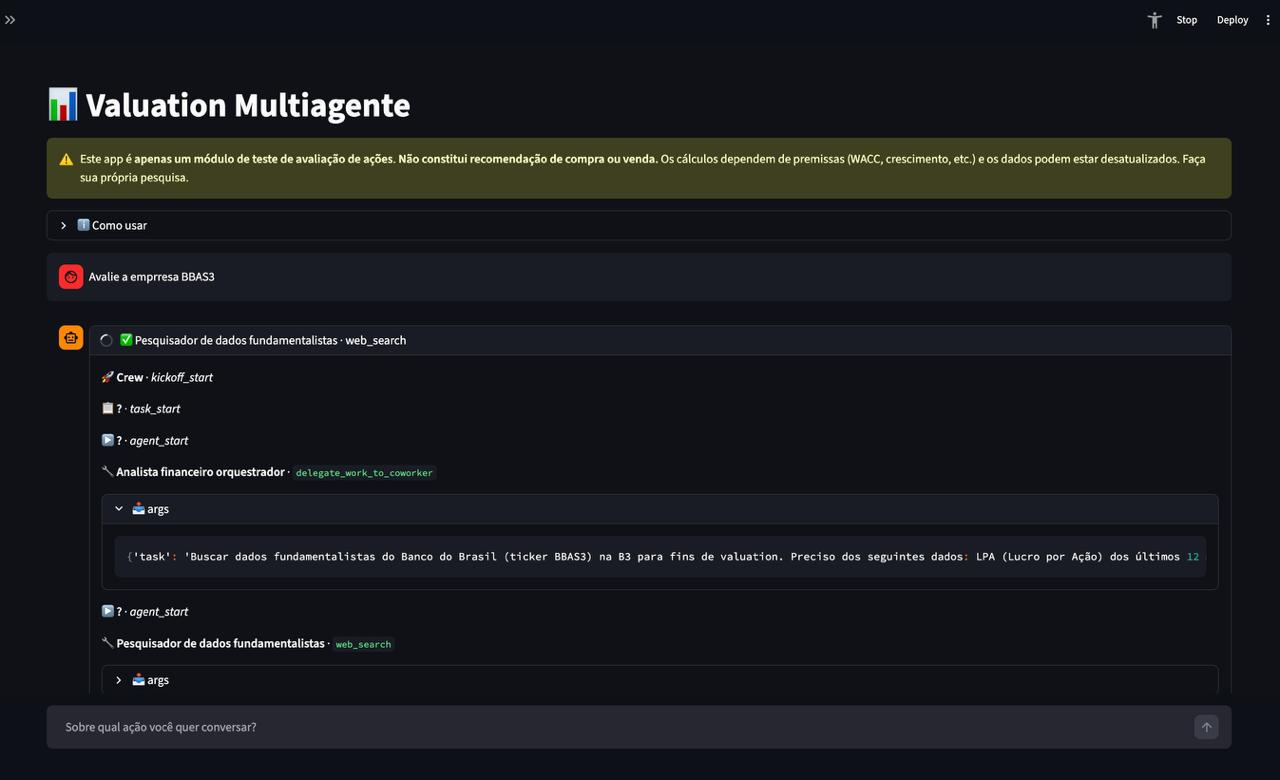
The screenshot above already captures the product's positioning: a conversational interface, an agent execution log, and a clear disclaimer about the experimental nature of the application.
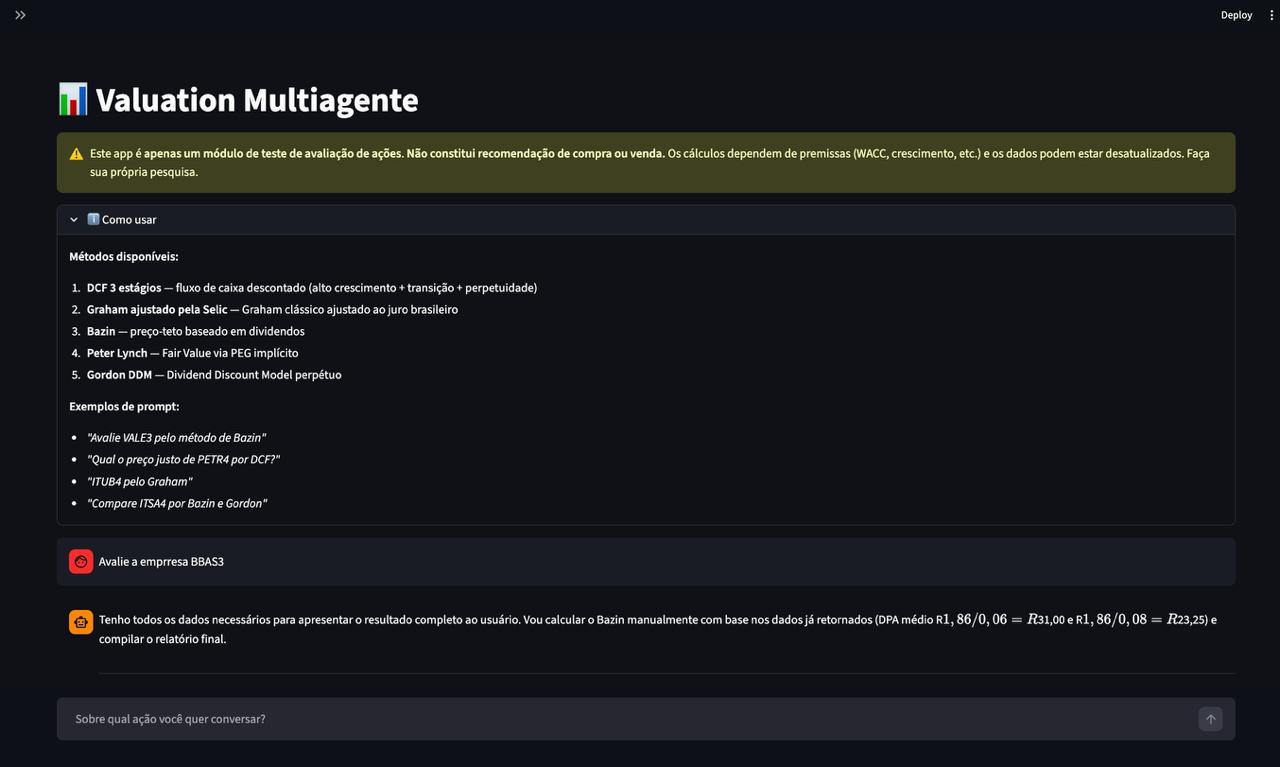
The usage screen makes the app's value proposition clear: letting users request valuations using different methods in a straightforward way, with example prompts and real-time textual feedback from the system throughout the process.
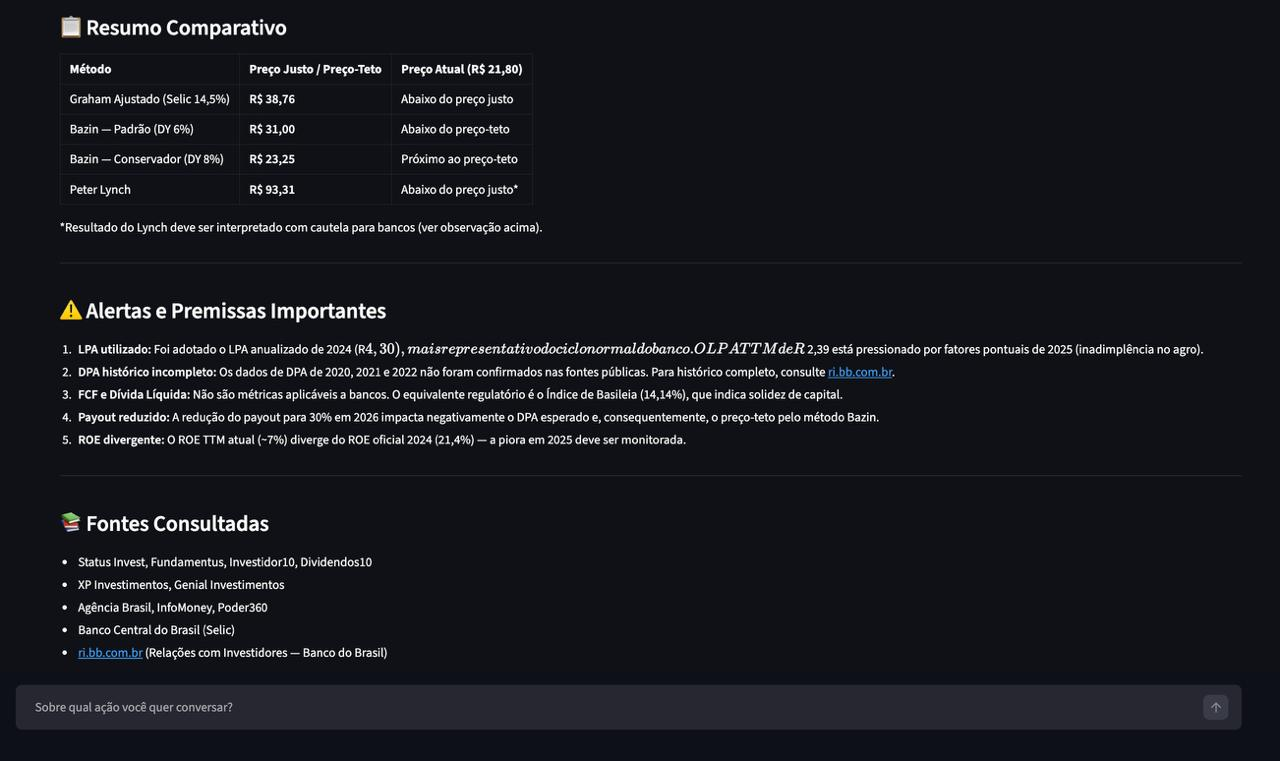
The final report goes beyond a single number. It compares results across methods, surfaces important alerts and assumptions, and lists the sources consulted, a critical feature when it comes to building trust in decision-support systems.
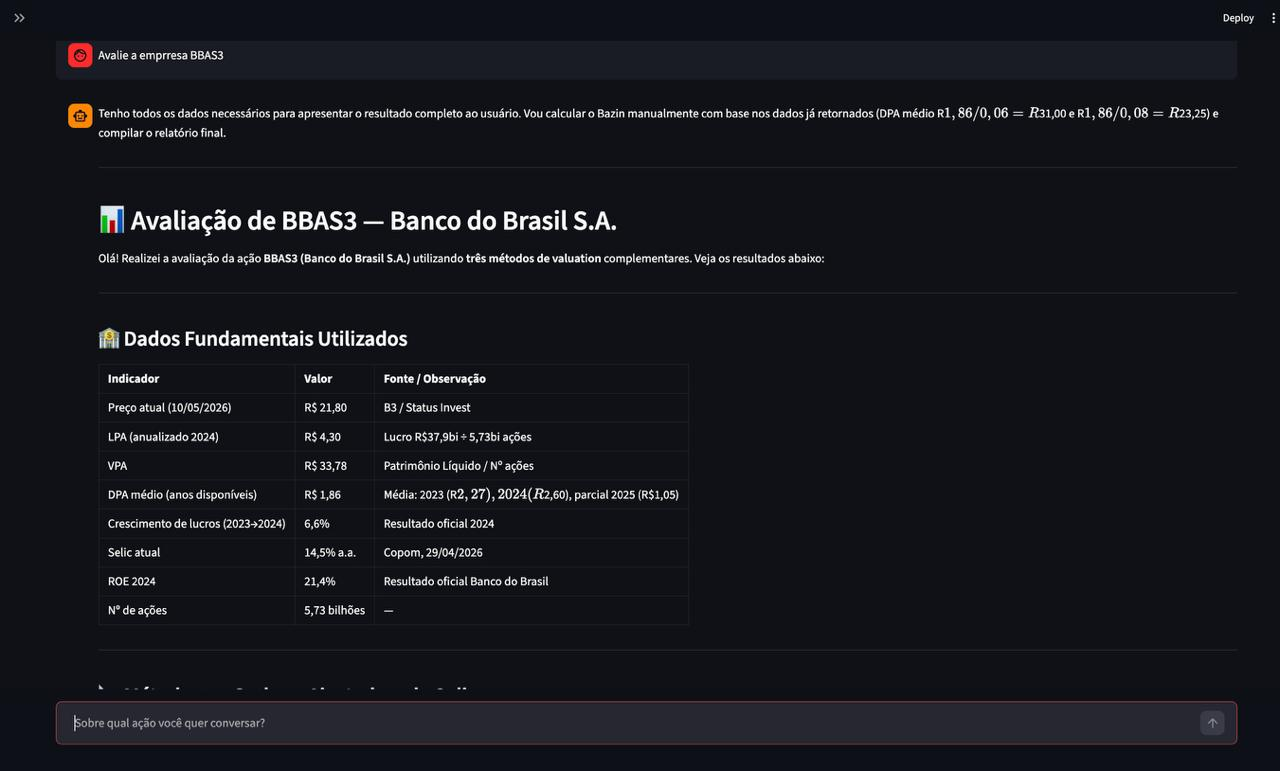
Another standout feature is the exposure of the fundamental data used in the calculations, such as current price, EPS, book value per share, average DPS, earnings growth, benchmark rate, ROE, and share count. This brings the user closer to the underlying valuation logic and avoids the "black box" feeling. The data visible in the BBAS3 demo reinforces this commitment to traceability and explainability.
What this project demonstrates
More than a valuation app, finance-ai demonstrates a construction pattern we consider genuinely valuable:
- agents with well-defined roles;
- a simple interface for complex tasks;
- clear separation between data collection, orchestration, and calculation;
- explicit explanation of assumptions and limitations;
- an open-source foundation built for evolution and experimentation.
This pattern can be reused across many other domains: document analysis, internal copilots, operational automation, data triage, research assistants, and human-in-the-loop workflows. It is the same reasoning that guides our work in exploring, building, and operating AI systems at bosq.
Stack and project structure
For those who like to look under the hood, the repository makes its organization immediately clear: a Streamlit UI, the main crew, specialized agents, web search tools, and wrappers for the valuation functions. The setup is straightforward, Python 3.11, uv, environment variables, and local execution via Streamlit.
That structural simplicity is an important quality. Experimental AI projects often fail due to over-abstraction or unnecessary dependencies. Here, the goal is clear: organize a functional, observable, and easy-to-evolve multi-agent workflow.
Open source, with responsibility
Like any system applied to finance, finance-ai needs to be used with context. The repository itself makes clear that this is a test module, dependent on assumptions such as growth rates and discount rates, and that data may be outdated. That transparency in communication is an important part of the project, and a principle we take seriously at bosq.
Explore the project
If you want to try the app, study the architecture, or use this foundation as a starting point for a more complete financial product, the repository is worth exploring:
- Repository: github.com/bosq-dev/finance-ai
If your company is looking to turn complex workflows into reliable AI-powered systems, with clarity, governance, and a focus on production, reach out to bosq. We build modules, copilots, automations, and pipelines that move from concept to real-world operation.
Tags: #StockValuation #ArtificialIntelligence #AIAgents #FinanceAI #CrewAI #MultiAgentArchitecture #OpenSource #FinancialAnalysis #DCF #GrahamMethod #Bazin #PeterLynch #GordonDDM #Streamlit #Python #FinTech #AIFinance #Bosq #AIcopilots #FinancialAutomation